

Quick pickled cabbage: cabbage, vinegar, water, salt, sugar, spices, garlic, bay leaf, and an hour later you've got a jar of crunchy, tangy, marvelously magenta cabbage.
Put it anywhere sauerkraut would go, or anywhere that wants brightness – tacos, sandwiches, alongside a latke smashed potato party or brisket. Or eat it straight from the jar. Any color or variety of cabbage works.
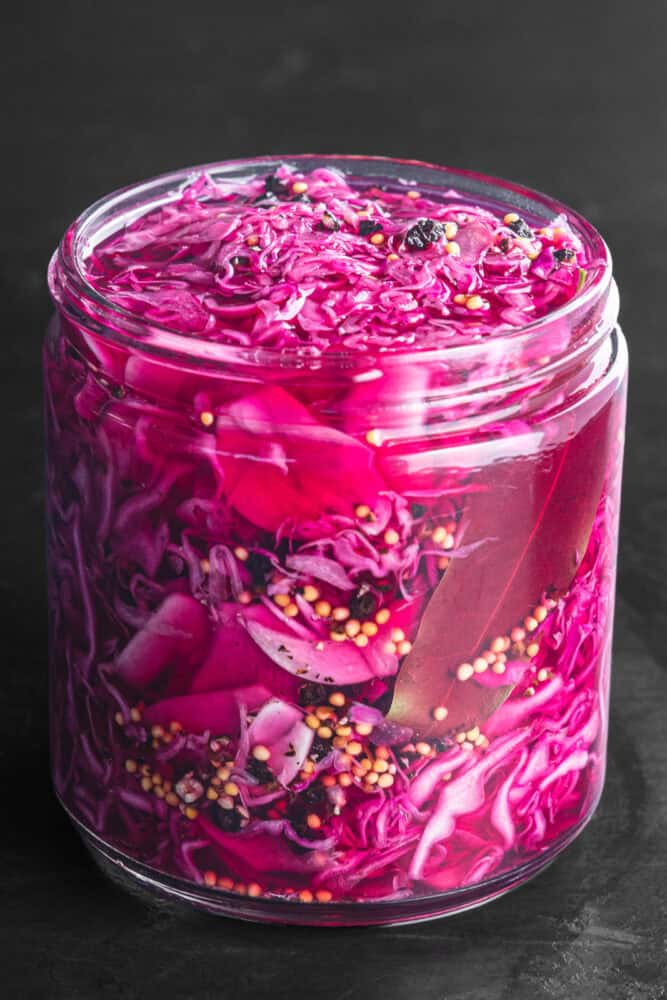
Two kinds of pickles exist: quick pickles (vinegar-based, what we're doing here) and fermented pickles (salt, time, naturally developing acid, like sauerkraut and kimchi). Both ancient. Both delicious. This is about the quickie kind. No special equipment, no canning required.
Quick pickling gets its tang from vinegar, fermentation builds its own acid over time, and canning is a separate step entirely – using heat to make jars shelf-stable.
And don't come at me, you pickling purists. Either which way ya pickle it, at the end of the day you're eating cabbage, and that's a win in my world.
Happy to sing the praises of naturally fermented foods all day long – quick pickles are just the friendlier entry point for anyone new to it.
I'm not arguing which way is better or healthier, I'm saying let's all eat veggies. I'll take mine any which way. Care more about how it's grown and harvested than how it's prepared. And pickled cabbage is sexy too.
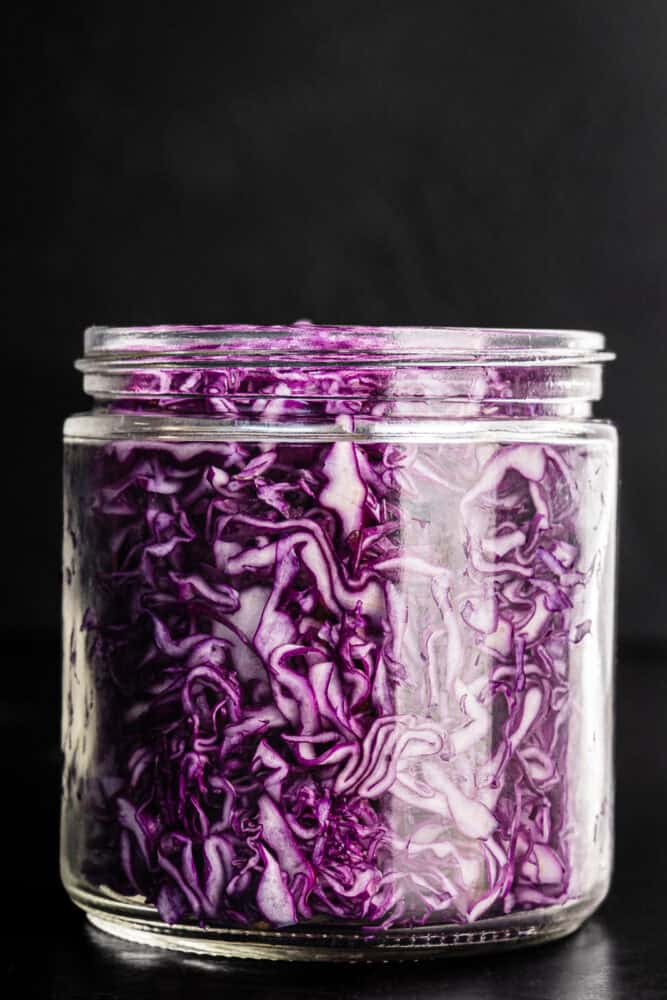
Slice the cabbage into very thin, shoestring-like strips. IMHO you'll need a mandoline for this – at least I can't quite get it as thin as I'd like by hand. Like I tell my students in cooking class: remember kids, we're cutting the veggies, not our fingers. There's a lot of fear surrounding mandolines. Yes, they're sharp AF. As soon as your fingers get questionably close to the blade, just stop. Never risk your fingers for those last few slices.
For this edition: mustard seeds and coriander do the heavy lifting – the backbone of pretty much any classic pickling spice, mustard for the sharpness, coriander for warmth and a citrusy lift. Black peppercorns bring earthy heat, red pepper flakes bring a sharper kick, garlic adds savory depth, and the bay leaf does its thang, rounding everything out with a subtle herbal note. Half apple cider, half white vinegar gives the brine a little fruity sweetness alongside its sharper acidity.
Cabbage is culinarily interchangeable – the biggest diff is you won't get the marvelously magenta result with any other color, but that's just a visual thang. Or you can do the beet cheat: add a chunk of raw red beet to green quick pickled cabbage, and it'll turn the cabbage and the liquid a bright magenta color.
Transform your cabbage with just vinegar, water, sugar, salt, spices.
My Pickling Wisdom
- Slice thin — if you have a mandoline, now is the time to use it. If not, slice as thinly as possible with a sharp knife.
- Mustard, coriander and black peppercorns are simply my suggestions. Experiment and play to make it your own spice-adventure situation.
- Store in the fridge, with the cabbage submerged in the brine, for up to 2-3 weeks.
- Serve on anything you’d serve with sauerkraut – sandwiches, tacos, sausages, grain bowls, and more.
And yes, you can pickle anything really – fruits or veggies, like radishes, carrots or beets.
If ya try this pickled carrot recipe, I'd love to hear about it – leave a comment below and let me know, and tag me on IG, @danielagerson, so I can see too!
Keep exploring for more seasonal recipes and colorful produce guides designed to inspire ya to play in the kitchen.
Let's make waves in the kitchen.
Quick-Pickled Red Cabbage
Ingredients
- ½ small head red cabbage thinly sliced (about 4 cups)
- ½ cup apple cider vinegar
- ½ cup white vinegar
- 1 cup water
- 1½ tbsp sugar
- 1½ tsp salt
- 1 tsp mustard seeds
- ½ tsp coriander seeds
- ½ tsp black peppercorns
- ¼ tsp red pepper flakes
- 1 garlic clove thinly sliced
- 1 bay leaf
Instructions
- Slice the cabbage: Thinly slice the cabbage. Pack it fairly tightly into a clean quart-size jar or heatproof container.
- Make the brine: Add the vinegars, water, sugar, salt, mustard seeds, coriander, black pepper, red pepper flakes, garlic, and bay leaf to a small saucepan.
- Heat: Bring to a gentle simmer, stirring until the sugar and salt dissolve. Turn off the heat.
- Pour over cabbage: Carefully pour the hot brine over the cabbage. Press the cabbage down so it's submerged as much as possible.
- Cool: Let it sit uncovered at room temperature for about an hour, pressing the cabbage down if needed to fully submerge in the brine.
Notes
- Slice thin – if you have a mandoline, now is the time to use it. If not, slice as thinly as possible with a sharp knife.
- Mustard, coriander and black peppercorns are simply my suggestions. Experiment and play to make it your own spice-adventure situation.
- Store in the fridge, with the cabbage submerged in the brine, for up to 2-3 weeks.
- Serve on anything you’d serve with sauerkraut – sandwiches, tacos, sausages, grain bowls, and more.

Leave a Reply